My memory isn't what it used to be. In fact, I'm afraid the electrical connections that once lit up my internal thought processes have lost their brightness. Before, entire storage spaces in my mind were brightly lit allowing me to access the most obscure information you could imagine. Now, those spaces are dark, occasionally lit by the flickering of a soon-to-be extinguished bulb.
I'm not as bold in conversations with friends and less so with strangers as a result. I fear for the stalled silences that immediately accompany a lost thread of knowledge or train of thought. Before, I could summon up the names of books, movies, authors, actors, plot lines, artists, etc. at the drop of a hat. Often one small association would trigger a string of thematically connected ideas that could dazzle even the most adept of cocktail conversationalists. Now I'm reduced to something like, "you know, the actor who played the general in that Sylvester Stallone movie where he went ballistic." Such are the ravages of age upon the cognitive process.
I try to keep my mind sharp with little exercises. I do the word scramble each day in the newspaper. I string together meaningful phrases out of the letters on license plates in front of me (e.g. GSC could equate to "girl scout cookies" or "go shoot coyotes"). I exercise every day (well, almost). I systematically go through the alphabet in my mind whenever I forget something, like the actor example above. ("Abraham? No. Bob? No. Collin?" etc.) Sometimes this methodology yields results but even when it does, it is often minutes sometimes hours after the initial thought should have been completed - a far cry from my "sharper" days.
I saw this phenomena creep up with my parents which does nothing to quell the internal terror. The only solace I can derive from all of this is that my older friends all seem to be suffering from the same malady. Our conversations no longer run smoothly as they sputter and stall upon those lost associations and references we used to grab readily. An astute onlooker could undoubtedly identify those moments of silence and stupor where both parties look at the ground in embarrassment (and in the vain hope that there might be some clue as to what we are looking for there on the ground). It all goes down easier when I know I am not alone.
In the meantime, in a real pinch, I can always go to my iPod. At least I can Google enough of my memory fragment to find the component I had forgotten. I try not to rely upon it too much though. I'm convinced that the iPod, like the calculator, has become a crutch that discourages us from more active mental participation. I suppose I'll know I'm in real trouble when I forget how to use the iPod or forget what the iPod in my hand is entirely. I do hate this memory loss thing. But then, by that time, I won't remember what it was that was troubling me.
Tuesday, December 20, 2011

Tuesday, December 13, 2011
rangefinder cameras revisited
Seriously, if you're not into cameras or have little patience with other's obsessions, be forewarned, you may want to skip this post.
It's been quite a while since I've posted anything and wouldn't you know that inspiration would be found in my penchant for conspicuous consumerism? Way back in March of 2010, I praised (in more detail than any but the most rabid of photographers would appreciate) the joys of rangefinder cameras. I won't bore you with a re-hash of that post, but am compelled to say that in retrospect, my purchase of the Panasonic GF1 while motivated by the similarities (at least in appearance) to the rangefinders of old, was totally misguided. In truth, the GF1 is a digital camera with a similar body style that offers interchangeable lenses, but in action, it does not possess enough of the rangefinder's DNA to qualify as a modern-day substitute.
I refer you once again to the photo below to clarify.

It's been quite a while since I've posted anything and wouldn't you know that inspiration would be found in my penchant for conspicuous consumerism? Way back in March of 2010, I praised (in more detail than any but the most rabid of photographers would appreciate) the joys of rangefinder cameras. I won't bore you with a re-hash of that post, but am compelled to say that in retrospect, my purchase of the Panasonic GF1 while motivated by the similarities (at least in appearance) to the rangefinders of old, was totally misguided. In truth, the GF1 is a digital camera with a similar body style that offers interchangeable lenses, but in action, it does not possess enough of the rangefinder's DNA to qualify as a modern-day substitute.
I refer you once again to the photo below to clarify.

The key feature of a rangefinder camera is the optical viewfinder in the upper right-hand corner of the camera (a Leica M3) displayed above. While single-lens-reflex cameras became the eventual standard for news photographers, sports photographers and consumers in the late 60s and early 70s, the blessing and curse of this design is that at the precise moment of exposure, the mirror that allows the photographer to see through the lens that is capturing the image, flips up to totally obscure the viewfinder.
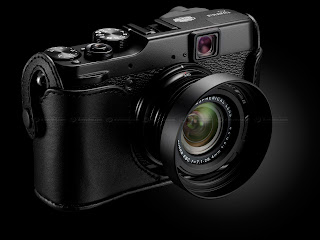
The rangefinder on the other hand, offers a clear view of the framed subject at all times since the viewfinder is simply a "window," clear glass if you will. In a sense, with SLR cameras, the decisive moment becomes the indecisive moment as you may or may not have captured what you intended. True, the digital cameras of today offer almost instantaneous feedback, but to the PURIST, in the spirit of a rangefinder camera, the decisive moment is still the moment when you depress the shutter release button as you compose through the viewfinder. (OK, OK, some of today's digital cameras offer electronic viewfinders eliminating the blackout problem, but the view is propagated by a micro-miniature television screen which makes it somehow offensive to technophobes such as myself). And so in an attempt to right my past wrong, I have recently purchased the new Fujifilm X10.

The first thing you should notice, now that you've been trained to spot rangefinder cameras, is the optical viewfinder just to the right and above the lens. It is this one key important feature that qualifies the X10 as a modern-day rangefinder and one that is lacking on almost every digital camera today. Sadly, the display on the back of these cameras has become de riguer these days. Cameras should not be held away from you, they should be snuggled against your face(which incidentally, helps steady the camera in a way not achieved otherwise).
And similar to the classic rangefinders, this camera sports a vast array of manual controls, those things called knobs and dials that have somehow been eliminated with touchscreens. You actually have to twist the lens to zoom in and out rather than push a lever that actuates a motorized zoom lens. How innovative is that? I suppose I'm betraying my reactionary ways here, but you should know I was "classically trained" as a photographer. Cameras were mechanical marvels back then, operated by gears and intricate internal mechanisms that coalesced in a perfect symphony of movement to adjust the lens opening, the shutter speed and align the film in the proper spot to capture a moment of time. Somehow the decisive click and tactile feedback of the shutter mechanism of those cameras proved to be immensely satisfying, unlike the electronic beep or simulated shutter sounds of today's devices. Yes there are more electronic parts than mechanical ones in the Fuji X10, and yes, it is a digital camera. But, Fuji has incorporated the interface and operation of those old rangefinder cameras in its latest model. There is a reassuring feel and look of a camera once more versus the evolving face of digital image capture devices (have you seen the Lytro?) I can return to my roots with this camera, back when I was first inspired to create images. Remarkably, I've found the "fun" again in shooting photos.
Friday, September 9, 2011
supernova

Last night, around midnight I went outside to see if I could witness the supernova. Supposedly, the zenith of the supernova's brilliance was to occur sometime between last night and this weekend. I looked patiently around, trying to find the Big Dipper, the landmark via which the supernova could be located. I utilized my Planets app on my iPod Touch to mark the position of the Big Dipper in the night sky, but to no avail. Either the clouds were obscuring it or the brightness of the moon was creating too much glare off of the atmosphere. I was of course disappointed, but realized as I stood there for what seemed an extended period of time that just being out there was beautiful. I paused at that moment to absorb it all, the cool summer breeze that hinted of the arrival of Fall, the quiet of the night, the vastness of the universe that lay outstretched above me and the silent, distant stars that flickered against the darkness. I didn't care that I couldn't see the supernova at that moment. Although it is a once-in-a-lifetime occurrence, there is something to be valued about what exists out there for us everyday.
Sunday, September 4, 2011
new profile photo

After approximately 5 months, I've successfully lost 20 pounds. Prior to this time, I've avoided posting any photos due to the vanity of an older man. Now that I've regained a thinner version of myself, above is a new profile photo.
Celeste of the Desert
Celeste is one of my oldest and dearest friends from college It seems we were always destined to be apart. Each summer, she would depart for El Paso, a place near and dear to her heart where she once lived and many of her friends continued to reside. We would write each other occasionally during her summer escapades or whatever she was doing back there in the hot desert climes of Texas. When fall brought her back to the U. we would resume our friendship once more.
Looking back, I've concluded friends are the ones who can tell you when you're full of crap, which Celeste did quite often. Believe me, people who don't tell you when you're full of crap aren't doing you any favors. Celeste could point this out to me in a way that caused me to pause and reflect upon my behavior rather than defend it blindly. (Wives replace friends in your later life. They are the ones who remind you about the crap except they are not so delicate about it. Men are never really in a position to tell their wives they are full of crap because they simply never are. Crap seems to be specifically gender-tied to men. But I digress . . . )
As was foretold by our early separations during college, our adult lives have followed the same path. Currently, Celeste has settled in the isolated desert of Arizona somewhere near Kingman. She is building her dream house there, but has met with some of the realities of the harsh environment there. She recently wrote me about some of the pitfalls of desert life. Without her permission I include it here:
My morning routine was interrupted when my peripheral vision caught Jack and Buddy, our dogs, quietly roaming through the side yard. I watched them for a moment and then saw Twilight, one of our cats, stretched out across his favorite nap spot. The sadness was almost immediate. I knew he was dead. Still, I walked out to him. He was on his side, his eyes half closed and his tail extended behind him as if pulled straight by a playful child. He would have jumped and sprinted had he been alive. I didn't touch him.
Cats are necessary on our ten acres surrounded by miles of desert. The cute, cup-eared, kangaroo rats ubiquitous in our area, draw Mohave rattlesnakes. The cats keep the scurrying mouse-like kangaroos in check. This is not to say we and our animals live a Mohave-free life. The tell-tale puncture wounds on Twilight's lip and nose confirmed one of the snakes got him. Green hued, Mohaves kill with one of the most lethal venoms of U.S. snakes.
The snake that killed Twilight is resting between garlic chicken and Lean Cuisines in the freezer waiting to be turned into a hat band or such. We aren't always able to get the perpetrator, but it helps a bit when we can. Coyotes and rattlesnakes are the prime predators. Gone are cats Sheba, Tom, Mama Cat, Sunny, and others. Sage, our beloved dog was lost to a mountain lion, and Buddy, who came after, both were bitten. Chickens Bandit, Samantha Jane, Sunny Skies, and Little Red, succumbed and chicks disappear before they can be named.
Looking back, I've concluded friends are the ones who can tell you when you're full of crap, which Celeste did quite often. Believe me, people who don't tell you when you're full of crap aren't doing you any favors. Celeste could point this out to me in a way that caused me to pause and reflect upon my behavior rather than defend it blindly. (Wives replace friends in your later life. They are the ones who remind you about the crap except they are not so delicate about it. Men are never really in a position to tell their wives they are full of crap because they simply never are. Crap seems to be specifically gender-tied to men. But I digress . . . )
As was foretold by our early separations during college, our adult lives have followed the same path. Currently, Celeste has settled in the isolated desert of Arizona somewhere near Kingman. She is building her dream house there, but has met with some of the realities of the harsh environment there. She recently wrote me about some of the pitfalls of desert life. Without her permission I include it here:
My morning routine was interrupted when my peripheral vision caught Jack and Buddy, our dogs, quietly roaming through the side yard. I watched them for a moment and then saw Twilight, one of our cats, stretched out across his favorite nap spot. The sadness was almost immediate. I knew he was dead. Still, I walked out to him. He was on his side, his eyes half closed and his tail extended behind him as if pulled straight by a playful child. He would have jumped and sprinted had he been alive. I didn't touch him.
Cats are necessary on our ten acres surrounded by miles of desert. The cute, cup-eared, kangaroo rats ubiquitous in our area, draw Mohave rattlesnakes. The cats keep the scurrying mouse-like kangaroos in check. This is not to say we and our animals live a Mohave-free life. The tell-tale puncture wounds on Twilight's lip and nose confirmed one of the snakes got him. Green hued, Mohaves kill with one of the most lethal venoms of U.S. snakes.
The snake that killed Twilight is resting between garlic chicken and Lean Cuisines in the freezer waiting to be turned into a hat band or such. We aren't always able to get the perpetrator, but it helps a bit when we can. Coyotes and rattlesnakes are the prime predators. Gone are cats Sheba, Tom, Mama Cat, Sunny, and others. Sage, our beloved dog was lost to a mountain lion, and Buddy, who came after, both were bitten. Chickens Bandit, Samantha Jane, Sunny Skies, and Little Red, succumbed and chicks disappear before they can be named.
Their deaths are inevitable in this unyielding environment where coyotes and snakes must kill to live . We know this, but each is missed and mourned and a small tragedy.
Friday, August 26, 2011
the man and the donut reunited
Monday I ordered two dozen apple cider donuts from Cold Hollow Cider Mill. They arrived via Priority Mail on Wednesday, neatly packed in airtight plastic bags, a little squarer for having been packed snugly in the box. Amazingly, all of the donuts were intact and appeared to be quite fresh. The enclosed instructions suggested that the donuts tasted best when served warm. Specifically, they suggested they be placed in the oven at 200 degrees for 3-5 minutes. Since I had the donuts delivered to my work address, I immediately placed one in our toaster oven. To my delight, they tasted every bit as good as I had remembered! The room was filled with the scent of apples and cinnamon.
That night, at home, I warmed up one for Joni. Sadly, it was warm enough but the surface had not re-crisped up like it had for me at work. At work, the exterior regained its crunchy hardness while the inner portion remained soft and airy. I was a little perplexed and disappointed. Perhaps the smaller area of a toaster oven was more efficient than the standard in-home unit. Regardless, I was a little discouraged. Without the crunch, the donut could not achieve its former glory.
The next day I tried heating a donut at work for a morning snack and realized that I had misread the setting dial on the toaster oven. I had set the heat to 200 degrees Celsius which translates to about 350 degrees Fahrenheit! As I had experienced the day before, the donut was crispy on the outside, soft and warm on the inside. Mystery solved! Tonight you can be sure I will be heating more donuts at the 350 degrees setting. And yes, I will be in donut heaven.
Thursday, August 4, 2011
addendum to the best doughnut

After reading my latest blog entry, a co-worker Googled "apple donut in Vermont" and actually located the apple orchard/bakery detailed in the post below. It not only still exists, but appears to have thrived and expanded. It is the Cold Hollow Apple Cider Mill located in Stowe, Vermont.

They offer their donuts (their spelling, not mine) in dozen batches and can be shipped anywhere. Circumstances preclude me from immediately ordering my first couple of dozen donuts, but you can be assured, I will faithfully report upon the experience once it has transpired. (Or, are some things best left to memory, like the first girl you had a crush on?)
Check out their website at: http://www.coldhollow.com.
Sadly, I can see my memory had embellished the Rube Goldberg donut machine. It appears thusly,

Subscribe to:
Posts (Atom)